BeanAnimals' Bar and Grill Articles RSS Feedhttp://beananimal.comumbraco 2.1.6RSS feed containing articles posted at the BeaAnimal.com website.enHydraulics for the Aquaristhttp://beananimal.com/articles/hydraulics-for-the-aquarist.aspx@updateDatehttp://beananimal.com/articles/hydraulics-for-the-aquarist.aspxMany aquarists get by without knowing the first thing about the physics of water. That said, I know many of you would like to know a little bit more about the physics of water and how they govern different aspects of your aquarium. We will touch on some basic design principles such as Hartford Loops and baffles as well as some real world flow calculations using Bernoulli's law and the basics of centrifugal pumps.

You may be thingking... "Physics? Who needs physics, this is an aquarium hobby bub?" Have you ever looked for a bulkhead flow rate calculator? Have you ever tried to figure out how much water your aquarium overflow can handle?

The driving force for writing this article is the high number of well intentioned, but poorly informed posts regarding different aspects of aquarium plumbing and flow rates. Terrible plumbing advice can be found in-bulk at just about any online aquarium forum. You will fine dozens of bulkhead flow calculators, but few of them are derived from anything more than anecodtal gueses or improperly applied physics.

How much water flows?

One of the most common questions is "How much water will flow through a bulkhead?" We can use a fairly simple equation to answer that question. The equation is the "Bernoulli Equation". According to Bernoulli's Law, the uncompressible fluid (water) will travel through an opening at a velocity(v) = sqrt (2*g*h) just like any other object FALLING out of a hole. Let's take a closer look at what Bernoulli said.

Daniel Bernoulli's Principle:

Bernoilli's Equation v=sqrt(2gh)
Where:
v = Velocity
h = Height
g = Gravity

Flow Rate: 

Flow Rate Equation
Where:
Q = Flow Rate
A = Cross Sectional Area
v = Velocity

So, we first solve for the Velocity of the water. The water has Velocity because gravity is pulling on it (it is falling).

We use the equation Bernoilli's Equation v=sqrt(2gh)  to find that Velocity. Once we find the Velocity of the water, we can find out how much water is falling because we know the Area of the pipe that that the water is draining (falling) through. That is, we use the equation Q = A*v to determine the flow through the hole.

I have built a simple flash based tank discharge calculator to do the math for you. Note: This calculator only works for systems where the drain is not able to suck air in along with the water. 2-Phase flow (when air is mixed with water) creates an entirely different set of problems that we will discuss later. This will work as a bulkhead flow calculator as long as the bulkhead is fully submerged and does not suck in air.


So if we have a standard 1" bulkhead that has an internal diameter of 1.033" attached to a pipe of the same diamter, and the pipe drops 24" to the sump, it will be capable of handling about 1,700 GPH of flow under full siphon! How do we setup an overflow that works on the principle of a siphon? See the Silent and Fail-Safe Aquarium Overflow project.

Check back for additions to this article. We will talk about a few other flow equations that can help us understand the flow of water in a pipe. We will also talk about the math of pumps. skimmers, baffles and other parts of the aquarium.

-Bean

]]>
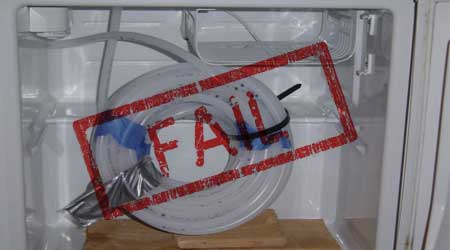
Dorm Fridge Aquarium Chillerhttp://beananimal.com/articles/dorm-fridge-aquarium-chiller.aspx@updateDatehttp://beananimal.com/articles/dorm-fridge-aquarium-chiller.aspxTank temperatures begin to creep up during the summer months. A common misconception is that a mini refrigerator (affectionately known as a dorm fridge) can be used as an aquarium chiller. The purpose of this article is to explain why that is pretty much an urban myth that is repeated daily in the reefing DIY circles.

The Short Version

Mini refrigerators are only capable of moving a very small amount of heat per hour. Their compressors are not designed to run an extended duty cycle with warm refrigerant. Adding coils of tubing and buckets of water do absolutely nothing to increase the efficiency or capacity of a refrigerator and instead only (and poorly) timeshift the heat transfer. A dorm fridge may work ok on a nano tank or very small reef (30 gallons or less) that has only a very modest heat load. If you are inclined to trust what has been said here, then consider yourself informed. If you still have your doubts or the itch to learn, then please, read on and become informed! Become a DIY warrior in the constant fight against misinformation.

The Long Version

You will see many chillers and air conditioners rated in "Horsepower".  This is very misleading. The Horsepower rating only shows how much work the motor can do. That would be fine if we were trying to do work on, or add heat to, a given system. We are not doing work, we are moving heat! That is why we have ratings like EER (Energy Efficiency Rating).

Let me explain: Horsepower is meaningful if you are converting electricity into work or directly into heat. With an electric heater, the energy put in must equal the energy out. This is a basic law of physics. With a motor, the energy put in must equal the heat + the work put out, basic physical laws at work again. However, when you are cooling via phase change, you are not doing the opposite. Instead, you are transporting heat out of the system, not producing "cold". So an air conditioner that uses 1000W of electricity produces 1000W of work+heat, however, it can move 5000W of heat out of your home! This is VERY important to understand.

Let me repeat that before we go any further! An air conditioner (chiller) MOVES more heat than it CREATES!

Let me repeat that before we go any further! If a 1000W air conditioner is in the window and a 1000W heater is in the same room, the air conditioner will win, hands down. Don't worry if you are still confused, I will show some examples to help make things clear.

Air conditioners and chillers commonly have their capacity rated in British Thermal Units (BTU). In general, a BTU is the amount of heat required to raise the temperature of one pound of water 1° Fahrenheit. Specifically, 1 BTU equals 1,055 joules. In heating and cooling terms, 1 "ton" equals 12,000 BTU (see sidebar for explanation of the logic).  In the converse, to cool 1 pound of water 1° Fahrenheit, 1 BTU must be removed. Remember the rating of the unit refers to how much heat it can MOVE, not the amount of energy needed to move that heat.

The Energy Efficiency Rating (EER) of an air conditioner is its BTU rating over its wattage. For example, if a 10,000-BTU air conditioner consumes 1,200 watts, its EER is 8.3 (10,000 BTU/1,200 watts).  

If 1 Watt = 3.412 BTU/hr, then the unit produces 4094.4 BTUs of heat (The motors, fans, friction, etc) that is absorbed by the air outside of the house but at the same time the unit moves 10,000 BTUs of heat from inside the house! Looked at another way: For every watt of energy that the AC unit consumes, it moves 8.3 watts worth of heat out of your home (or tank).

Now we have a basis for understanding some of the numbers and units that we will use to examine the dorm fridge chiller. From the above discussion it should also be very clear that buying a "1/5 HP" or "1/X HP" does not really tell you how much cooling capacity is available! The power rating just tells you how much energy the unit will suck out of the wall! 

Mini refrigerators come in various sizes with compressors rated between 1/20 Horsepower and 1/8 Horsepower. As we noted above, the horsepower rating is pretty much meaningless and is only applicable if we care about the efficiency of the overall system, that is how many Joules of heat can be moved per Joule of energy consumed by the chiller. The average cooling capacity of a dorm fridge is somewhere around 150 BTU/hr, that is, it is capable of moving 150 BTUs of heat in 1 hour, regardless of how efficient (or inefficient) it is in terms of energy usage. For the purposes of comparison, a small window air conditioner can move 5,000-8,000 BTU/hr! If you step up to a mid size unit (the neck high models) they will be closer to 500 BTU/h.

Stop! That is not the whole story! The dorm fridge uses about 30% of its capacity just to keep the interior cool!  

So lets put those numbers to work, shall we! We will take a target 75 Gallon system and model it with a decent 250 BTU/hr small refrigerator. Remember that 250 BTU/hr refrigerator will be able to devote about 175 BTU/hr to cooling the tank, the rest is wasted due to the design of the refrigerator!

If seawater weighs 8.5 pounds per gallon, then 75 gallons of seawater weighs 637 pounds. From what we learned above, we can say that it takes 637 BTUs of heat to change the tanks temperature by 1° Fahrenheit. It follows that our dorm fridge, working a 100% duty cycle (more on this later), can only drop the tanks temperature by .28° Fahrenheit per hour (or 1° Fahrenheit every 3.6 hours).

Lets expand on this example: Assume during the hottest 7 hours of the day, the tanks temperature rises from 80° Farenhiet to 87° Farenhiet without a chiller. We can translate this directly into BTUs! That is a 7° Fahrenheit temperature rise, or 4459 BTUs of heat that must be removed from the tank. Lets also assume that other 17 hours left in the day are cool enough for the tank to lose temperature on its own. Lets be kind and assume that the tank drops back down to 83° Fahrenheit by the start of the next hot period. Now lets model the dorm chiller on that same tank! 

There is a LOT more that goes on here (the heat gain and loss are not directly linear, but the following is close enough for you to get the idea).

Lets look at a day in the life of the chiller and tank: It should also be noted that this example ignores the added heat by the chiller circulation pump and the extra heat load that the chiller adds to the room!

HOUR

START
TEMP

ROOM
BTU

CHILLER
BTU

NET BTU

END
TEMP

10 AM80.0    637.5    -175     462.5    80.0   
11 AM80.7    637.5    -175      925.0    81.5   
12 PM81.5    637.5    -175     1387.5    82.2   
1 PM82.2    637.5    -175     1850.0    82.9   
2 PM82.9    637.5    -175     2312.5    83.6   
3 PM83.6    637.5    -175     2775.0    84.4   
4 PM84.4    637.5    -175     3237.5    85.1   
5 PM85.1    -112.5    -175     2950.0    84.6   
6 PM84.6    -112.5    -175     2662.5    84.2   
7 PM84.2    -112.5    -175     2375.0    83.7   
8 PM83.7    -112.5    -175     2087.5    83.3   
9 PM83.3    -112.5    -175     1800.0    82.8   
10 PM82.8    -112.5    -175     1512.5    82.4   
11 PM82.4    -112.5    -175     1225.0    81.9   
12 AM81.9    -112.5    -175     937.5    81.5   
1 AM81.5    -112.5    -175     650.0    81.0   
2 AM81.0    -112.5    -175     362.5    80.6   
3 AM80.6    -112.5    -175     75.0    80.1   
4 AM80.1    -112.5    -175     -212.5    80.0   

As you can see, not only does the dorm fridge run for almost 20 hours, but it can not keep the tank temperature from rising above a critical level! 

It is time to talk about duty cycle! A refrigerators compressor is not designed to run nonstop. The motor and compressor are designed to run short duty cycles of an hour or so and kept cool by the refrigerant and oil inside of the system. Long duty cycles cause excessive heat buildup in this type of compressor and will shorten its life. If you have any doubts, leave the door to your mini-fridge open and you will find that the compressor burns up in a matter of a day or two!

If the dorm fridge is capable of moving 175 BTU/h then we do not want a heat load that exceeds 30%-50% of that. A suitable heat load for a dorm fridge chiller is somewhere in the neighborhood of 50-80 BTU/h depending on the unit.  Smaller units may be closer to 30 BTU/h of acceptable heat load.

So what kind of tank are we talking about?  Lets look at a 20 Gallon system that runs at 83 degrees without a chiller but has a target temperature of 80 degrees. The ΔT (Delta-T, or temperature change) is 3° Fahrenheit.  Lets again assume that this 3° Farenhiet is gained over an 8 hour period if the tank has no chiller.  20 Gallons of seawater at 3° ΔT is  63.75 BTU/h. A MID SIZE refrigerator could be used here and would run about 50% of the time during the hot part of the day. The smaller dorm fridge will still be overtaxed due to an excessive duty cycle during the hot part of the day!

The efficiency of these systems is also very low. The systems are not charged to handle the large temperature swings, but instead are designed to keep the interior cold with an occasional small heat load (putting your warm six pack in to cool it down over a day or so).

As stated at the beginning of the article, the dorm fridges are suitable for no more than a nano or very modest heat load on a small tank. You will find many people who claim to have used such a DIY chiller on a larger tank. When the facts are looked at, it becomes obvious that the tanks heat load was nowhere near what was claimed! You simply can't cheat the physics folks. 

Alternatives

For those hell-bent on a DIY chiller, a cannibalized window shaker is ideal. The project will take a fair amount of skill and an extensive tool kit. For most people this means spending more time and money than the project is worth! See the projects pages for an upcoming DIY chiller build!

For those less brave, you may want to consider evaporative cooling! It is the most efficient way to cool a tank. You get over 8000 BTUs of cooling per gallon of water evaporated!

-BeanAnimal

]]>
HID Lighting Explainedhttp://beananimal.com/articles/hid-lighting-explained.aspx@updateDatehttp://beananimal.com/articles/hid-lighting-explained.aspxThis article is an extensive technical overview of High Intensity Disharge lighting technologies. Much of the content for this article, including the drawings and photos, have been made possible by Paul Erik Hirvonen.

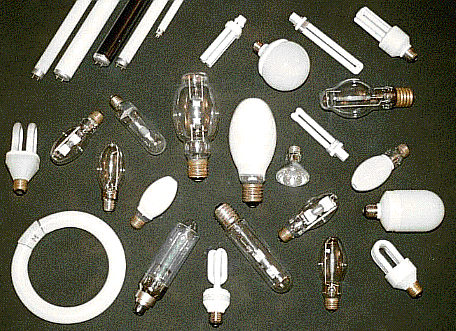
  lighting assortment 

HID Lighting Defined 

High-intensity discharge (HID) lamps create light by forming an electric arc between tungsten electrodes contained inside a quartz or fused alumina tube. The arc tube is filled with metal salts and gas. The gas supports the initial arc and helps to heat up and evaporate the metal salts. The evaporated metal salts create a high intensity plasma arc.


HID Lamp Types

There are four basic types of HID lamps. Mercury Vapor, Low Pressure Sodium, High Pressure Sodium and Metal Halide. Each lamp differs in its shape, gas charge and details of operation. Metal Halide lamps are the primary type used in the reef hobby. The basics of the other types will be covered for continuity and context.

 Mercury Vapor Drawing

 Low Pressure Sodium Drawing

 High Pressure Sodium Drawing

Metal Halide Drawing 

 Mercury Vapor

 Low Pressure Sodium

 High Pressure Sodium

 Metal Halide


Mercury Vapor Lamp DetailsMercury Vapor (MV) was the first HID lamp. It was introduced in the 1930's. MV usually has an outer bulb and an inner bulb (arc tube).  The arc tube is made out of quartz and contains mercury and argon gas.  A mercury vapor arc tube normally has three electrodes. One electrode (starting electrode) is used for starting the main arc. The ballast ignites the bulb using the peak/OCV voltage. When electricity is passed through the mercury/argon mixture iy produces blue/green light. Modern mercury vapor bulbs are available with a phosphor coating that balances the light spectrum and improves the CRI making the emitted light appear white. Clear MV bulbs with an added blue glass filter will work as a black light.

MV lamps are now commonly being replaced with other HID lamp technologies with improved efficiency or color rendering. MV is the least efficient of HID family. Some MV (self ballasted) lamps can directly replace incandescent bulbs without the need of a ballast. These MV bulbs use a filament for power regulation. MV lamps are manufactured in many shapes (PAR, R, ED, BT, A, T). One reason MV is still used today is because the rated bulb life is very good (some 24,000+ hours).

Mercury Vapor Usage:

  • Replacing incandescent lamps
  • General indoor lighting
  • General outdoor lighting
  • Security lighting
  • Aquarium (non reef) lighting
  • Plant lighting


Low Pressure Sodium DetailsThe Low Pressure Sodium lamp (LPS) was developed in Europe in the 1930's. The LPS lamp is not a true HID lamp. The LPS operates like a low-pressure mercury/argon tube (Fluorescent).  These lamps were very popular in Europe but never gained significant popularity in North America. The LPS lamp has an inner bulb and an outer bulb. LPS lamps use neon/argon gas to start up and contain sodium to produce yellow light. The bulb needs a special inner bulb because standard glass / quartz glass can't  withstand metallic sodium.

The lamp may be started by an ignitor, or without the ignitor if the ballast has a high enough peak / OCV voltage. Light output is monochromatic 589 nm. The 1800K color temperature is one of the primary reasons that the LPS never took a foothold in North America. Everything under LPS lighting is cast in a yellowish gray tone. Some cities/states are starting to use LPS lamps to decrease light pollution. The LPS bulb was improved by putting a reflective coating on the outer bulb to reflect heat back into itself. LPS is the most efficient HID lamp (100-183 Lumens per Watt). LPS bulbs are commonly available in 18 - 180 Watts and only in tubular shapes.

Low Pressure Sodium Usage:

  • Non-color critical lighting 
  • Outdoor lighting
  • Security lighting
  • Road lighting


High Pressure Sodium Lamp DetailsThe High Pressure Sodium (HPS) lamp is a high-pressure version of a LPS lamp. The higher pressure makes the lamp less efficient but produces a more pleasing light. The arc tube material can't be made out of quartz because of the sodium ( the as the LPS). The HPS lamp came nearly 30 years after the development of the LPS and is a result of development of an arc tube to that can withstand sodium at high pressures.

The HPS lamps start up by using an ignitor and/or argon gas. Most HPS lamps need an ignitor to provide a starting voltage of 2.5kV or more.  Special lamps are available that use the ballast peak/OCV voltage for starting (cutting production and maintenance costs).

HPS has become extremely popular everywhere because of its 90-140 Lumen per Watt efficiency. It also has a more balanced spectrum than its LPS sibling. A standard HPS lamp produces a golden colored light with a CRI around 20 and a color temperature of 1900-2100K.  Modern HPS lamps are manufactured with a higher color temperature and an improved CRI. HPS lamps are manufactured in many shapes (R, T, ED, BT, DE) and commonly available in sizes from 35-1000 watts.

High Pressure Sodium Usage:

  • General lighting
  • Indoor lighting
  • Outdoor lighting
  • Road Lighting
  • Plant lighting


Metal Halide DetailsMetal Halide (MH) lamps were introduced in the 1960's primarily for industrial use. Like the other members of the HID family, MH lamps are high pressure/high temperature arc lamps with an inner quartz arc tube and and outer glass envelope.

MH lamps come in two basic flavors, probe start and pulse start and cover a wide range of lamp and ballast configurations. Probe start bulbs use ballast peak/OCV voltage to start the arc and pulse start bulbs use an ignitor.

MH lamps have become exceedingly popular due to their wide range of spectral options and wattages that are available. The lamps are now commonly used in commercial and residential applications where high output and efficiency are desired. Lamps now come in double ended versions as wel as the standard mogul (screw type base).

Probe Start Bulbs

 Pulse Start Bulbs

 Arc Tube Types

Arc Tube Details

Probe Start

 Pulse Start

 Arc Tube Types

 Arc Tube Detail

Metal Halide Usage:

  • High-bay lighting
  • Outdoor lighting
  • Road lighting
  • Aquarium (including reef) lighting
  • Plant lighting
  • Projector lighting
  • Fiber optic lighting
  • Medical lighting


HID Startup Characteristics

Illustration of HID Probe Start CharacteristicsMercury vapor and probe start metal halide bulbs use the peak voltage/OCV to start the lamp. The high voltage and current needed to create the initial startup arc causes a lot of wear on the electrodes. When the arc has stabilized and the lamp is operated horizontally, the arc takes in a natural bend. For this reason, some bulbs have curved arc tubes to improve light output for horizontal operation.


Probe Starting Photo


Illustration showing HID pulse start details

Ceramic MH, standard European MH, pulse MH, and double-ended MH normally use this pulse (ignitor) method for starting. This method usually provides better lamp life and lumen maintenance because the ignitor causes less stress on the main electrodes vs. probe start (the ignitor uses high voltage but less current). Bulbs designed for ignitor + ballast should not be used on standard probe start ballasts (American ballasts). This can cause excessive stress on the electrodes or the ballast will not be able to start the bulb. That said, someprobe start bulbs seem to operate on ignitor + ballast systems but some bulbs arc OUTSIDE of the arc tube!  This may shorten the life or even short out the ignitor.  If the bulb was made in Europe and the specs say to use 4kV for starting than an igntior must/should be used.

 Photo showing pulse start initial arc

 Photo showing nearly complete pulse startup arc

Photo showing pulse start complete


HID Ballast Types

The purpose of the HID ballast is to regulate the voltage and current that are provided to the lamp during startup and under normal operating conditions. Each type of bulb requires a specific set of starting and operating parameters. This section focuses on magnetic ballasts. Electronic ballasts will be discussed separately. The most common type of magnetic ballast used in North America is the Constant Wattage Autotransformer (CWA).


Photo of assorted HID Ballasts


Magnetic ballasts come in two basic styles, the core & coil and the f-Can. Core and coil ballasts are pictured above and consists of a transformer, capacitor and possibly an ignitor. Many commercial applications use the core & coil ballast because the parts are easily replaceable. The components must be placed inside a suitable metal enclosure. The enclosure helps prevent fires and shields other equipment from interference. An enclosure is not optional!

F-Can ballasts have the same basic components but they are sealed (potted) in an epoxy or tar like compound. Many people refer to these as TAR ballasts. The potting compound allows the ballasts to be used as-is, without the need for an external enclosure. The compound also help keeps noise to a minimum by preventing the core from buzzing or vibrating.

(R)
The Reactor ballast is the simplest HID ballast circuit. A reactor ballast consists of one coil that regulates power and does not transform the voltage. This means the ballast input voltage must be the same as the OCV or higher than the required OCV. The R type is commonly used in Europe because the input voltage is higher than in North America.

  Reactor HPF Ballast Schematic

Reactor HPF with Ignitor Schematic

Reactor NPF Ballast Schematic

(R) HPF BALLAST

(R) HPF BALLAST W/IGNITOR

 (R) NPF BALLAST


(CCR)
The Controlled Current Reactor ballast is in the same family as the (R) reactor ballast and replaces CWA style circuits in some instances.

(HX-HPF and HX-NPF) 
The high reactance autotransformer ballast uses two coils. One coil transforms the voltage while the other regulates current. This ballast performs like the (R) ballast but works at lower input voltages and normally has multi-voltage input.

HX-HPF With Ignitor

Illustration of HX-NPF Ballast With Ignitor

Illustration of HX-NPF Ballast Without Ignitor

HX-HPF BALLAST

HX-NPF BALLAST

HX-NPF BALLAST WO/IGNITOR


(CWA)

The Constant Wattage Autotransformer ballast uses two coils and is frequently referred to as a lead style ballast. The biggest difference from the reactor and HX-HPF is that the capacitor is connected in series with the ballast secondary coil or in series with the lamp. This ballast offers better power regulation than the reactor and HX-HPF/HPF-NPF. The down side is the CWA ballast is larger, less efficient and sometimes more expensive to manufacture.

  Illustration of CWA type Ballast

 Illustration of Super CWA Ballast

CWA BALLAST

SUPER CWA BALLAST


(CWI)
The Constant Wattage Isolated transformer is similar to the CWA but the primary and secondary coils are electrically isolated from each other. These ballasts are more common in the Canadian market because of the Canadian Electric Code. These ballasts are normally larger and less efficient than the similar CWA ballasts.

Illustration of CWI Ballast

Illustration of CWI Ballast with Ignitor

Illustration of basic CWI Ballast

CWI BALLAST

CWI BALLAST W/IGNITOR

BASIC CWI BALLAST


(Regulated Lag)
The magnetically regulated ballast is one of the most sophisticated circuit designs. The Regulated Lag ballast uses three coils to provide the highest power regulation to the lamp. This ballast circuit is beneficial for lamp life and lumen maintenance. It is larger and less efficient than other types of ballasts available. This ballast overcomes many problems with input voltage variations.

Illustration of Regulated Ballast with Ignitor

Illustration of Regulated Ballast

REGULATED BALLAST W/IGNITOR

REGULATOR BALLAST


HID Ballast Notes

CWA with the cap in series with the lamp only have been known to over ride some MH AND HPS lamps. European MH lamps are usually designed for R/HX (eactor/high reactance auto transformer) ballasts. When operated on CWA (CWA with the cap in series with the lamp only) these lamps have reduced lamp life and are notorious for cycling on/off (the lamp warms up and then turns off.)It is very important to match lamps with the proper ballast system.  Each lamp has its own requirements. One ballast system will not operate all types of lamps properly. A ballast cannot be manufactured to match all the requirements. If the lamp requirements are not met  (like using a lamp not designed for that ballast) less light output and/or shortened lamp life or other problems could occur.


Ignitors

Photo of Typical HID IgnitorSome lamps need ignitors for proper starting. Standard High Pressure Sodium and some Metal Halide lamps need ignitors.  Low Pressure Sodium lamps may need an ignitor to light up (depending on the ballast type and open circuit voltage). The ignitor provides the proper starting voltage to the lamp. The voltage depends on the ignitor and ranges from ~600V to 6kV.  
Most European MH lamps require the use of an ignitor. Standard North American MH lamps usually do not need or should not be used with ignitors. Using pulse ignition MH lamps on non-ignitor systems could cause premature lamp failure. A standard North American ballast (non-ignitor system) will cause excessive stress on the electrodes. Some pulse ignition lamps may not even light on these ballasts.

Standard North American MH lamps use the Open Circuit Voltage (OCV) for ignition. This type of starting is extremely stressful on lamps. The ballast provides the lamp with the proper voltage (like an ignitor) but with higher current. Lamps designed for this type of starting will have an extra electrode. This electrode (starting electrode) starts the lamp and is usually connected to a switch or resistor inside the lamp.  
Mercury Vapor operates like the Standard North American Metal Halide (self-starting)


Capacitors

caps


Warm Up Time

warmup


Capacitor information and ANSI ballast types to follow, stay tuned!

ANSI Ballast Types


]]>
Electricity for the Reeferhttp://beananimal.com/articles/electricity-for-the-reefer.aspx@updateDatehttp://beananimal.com/articles/electricity-for-the-reefer.aspxEvery aquarium forum is full of electrical questions and opinionated answers. As with most of the articles here at BeanAnimal.com, I will attempt shed some light (no pun) on the subject from a fact based perspective. Too many times, electrical questions are answered poorly based on the opinion of a well meaning but misinformed DIYer. We will look at a multitude of subjects and try to cover most of the common questions and concepts that a DIYer will run into.


Disclaimer

I will put this very bluntly. You should enlist the expertise of a fully licensed electrician before working with the electrical system of your home or building projects that will plug into that electrical system. The information provided here is for entertainment purposes only, use it at your own risk! If you do not fully understand what you are doing you could easily hurt yourself or your family! Electricians can read too! If you need help, show your electrician this page, he (she) will be able to implement some of these ideas for your system!


The Basics

Having a basic understanding of our electrical system is important if you wish to undertake DIY projects. Most of our homes are wired with what is called a split-phase (3 wire) system, that is, the transformer supplying your home has a single-phase input (the primary winding). The output (secondary winding) is center-tapped. The center tap is connected to neutral (the ground). Phase to neutral voltage is 120 V on both sides of the center tap and 240 V between the two hot conductors. The graphic below illustrates this stepdown transformer and how your household voltage is derived from it.

 
Split phase step down transformer showing neutral and hot legs

We end up with 240 V service that is split into (2) 120 V conductors that are 180° out of phase with respect to each other. Small appliances and lighting fixtures can be connected between the NEUTRAL and one of the HOT conductors, giving the device 120 Volts. Larger appliances are designed to be connected between both HOT legs, giving them 240 Volts to work with.

 
Graph of a split phase sine wave
The image above shows the time domain graph of the 2 HOT legs that feed your home. Green is Leg 1, Red is Leg 2. As you can see they swing from -170 Volts to +170 Volts in a smooth sine wave, this swing happens at rate of 60 times per second, or 60 Cycles. So every 1/30th of a second the voltage crosses zero Volts and heads towards the next + or - peak.  You can think of the 0 Volt axis as the neutral. The 120 Volts signal that we are familiar with is actually a 170 Volt signal, but the RMS average (Root Mean Square) is 120 Volts! We will talk more about sine waves later, as they are very important when we discuss the operation of motors and backup power supplies. The goal here is to make it clear that our AC power is a true sine wave that has a frequency of 60 Hertz.

So we now know that our electricity is delivered in the form of a true sine wave and that it comes in on two hot wires that have an RMS voltage of 120 Volts each when a meter is placed between either and the Neutral or Ground. We also know that if a meter is placed between the two hot legs we get a reading of 240 Volts RMS. Why would we want to have two different voltages in our homes? To answer that question, we will need to touch on the basics of a Law that governs everything electrical. Read on...


OHM'S LAW

Ohms Wheel showing all possible combinations of Ohm's LawOhm's law governs everything electrical. Having a basic grasp of Ohm's law will open the door to understanding electrical systems. The intent of this article is not to give an exhaustive lesson on such things, but rather, to give a basic overview of electricity as it relates to our hobby. With a basic understanding of these concepts you can work safer and with more confidence about your projects. If you click on the image to the left you will be presented with what is called the Ohm's wheel. It is a graphical representation of all of the formulas that make up Ohm's law. Don't be discouraged, it is much simpler than it looks. Knowing two basic equations and a few simple concepts will fill in all of the gaps. 

I - Current in AMPS. This is the basis for everything else. 1 Ampere is equivalent to 6.28 billion billion electrons per second passing a given point in a wire. Ponder that one for a moment! Pure physicists may argue a bit about the way I have presented this, but you get the point, we are counting electrons moving past a point in one second.

E - Potential in VOLTS. E stands for Electromotive force. It is not uncommon for people to use V instead of E. The VOLTS are what pushes the electrons.

R - Resistance in OHMS. R stands for Resistance. The RESISTANCE is what tries to stop the electrons from being pushed down the wire.

E and R are derived from I. Very simply put, One volt is the amount of electromotive force required to force one amp to flow through one ohm of resistance. With that we can build a very simple mathematical equation. VOLTS = AMPS × OHMS or properly: E = I × R  

P - Power in WATTS. Power is the amount of work done or energy transferred per unit of time. WATTS = VOLTS × AMPS or properly: P = E × I

We can think of VOLTS as the pressure that pushes electricity through the wire and we can think of AMPS as the amount of electricity that flows through the wire. OHMS can be thought of as the restrictions in the wire that keep the VOLTS from pushing the AMPS though the wire. We can compare this to a simple water pump setup. The water pump produces pressure that pushes water through a pipe. The larger the pump, the more pressure it can produce to overcome the restrictions in the pipe and therefore pump more water through the pipe. 

If you look back at the Ohm's wheel, you will notice that each formula is derived from either E = I × R or P = E × I

Knowing that little piece of information is critical if you want to work with electricity or electronics at any DIY level. Furthermore, knowing any two will allow us to solve for the third!

So why do we have 120V and 240V in our homes? Using Ohm's law, we can see that doubling the voltage reduces the current by half for the same amount of power!

Lets take a clothes dryer as an example. The typical electric clothes dryer is rated at about 4000 watts. Using Ohm's law: 

4000 Watts ÷ 120 Volts = 33.3 Amps
-or-
4000 Watts ÷ 240 Volts = 16.6 Amps

What is the advantage? Very simply, we can use a smaller circuit breaker and smaller gauge wire to carry the smaller current. This is safer and more efficient!

Yes, more efficient! Heat causes resistance and resistance causes heat. The more current that you try to push over a wire, the hotter the wire will become. The hotter the wire becomes, the more it will resist the flow of electrons! So lowering the current also lowers the resistance and increases the efficiency. The advantage in your home may be very small, if at all relevant. In large industry the saving most certainly add up.


240 Volt Equipment

It should be noted that many vendors offer 240 Volt ballasts and pumps. It is against the NEC and many local codes to use 240 Volt lighting fixtures inside of a home. It is also not the ideal scenario when dealing with water. The 240 Volt pumps are suitable but there is little real world advantage to using them in a residential setting. Most of the pumps in our fraction horsepower models that draw very little current.


3 Phase Equipment

It is becoming rather common for technically inclined DIYers to build wave makers that use 3-phase fractional horsepower motors and programmable 3-phase converters. This is a complex subject and beyond the scope of this primer. Look for an upcoming DIY project here at beananimal.com!


CIRCUIT BREAKERS

A circuit breaker is a device that automaticaly intterupts the current flow in a circuit if a preset amount of current flow is exceeded. The circuit breaker is designed to protect the circuit from damage due to a short circuit or overload. The circuit breaker IS NOT designed to protect YOU the human from shock or *electrocution.

Circuit breaker sizing is confusing for many DIYers. Put simply, the circuit breaker must be sized to protect the smallest run of wire in the branch circuit. 12 Gauge wire is rated to be protected by a 20A circuit breaker and 14 Gauge wire is rated to be protected by a 15A circuit breaker. You CAN NOT simply replace a 15A breaker with a 20A model because you need more capacity. You MUST ensure that the entire circuit is wired with #12 wire before doing so!

Circuit breakers are only to be loaded to 80% of their rated capacity! If you load them past that point, you will experience nuisance tripping and possibly an eventual weakening of the breakers trip mechanism (causing more nuisance tripping). We can use Ohm's law to show exactly what this is true. We will use P = E × I

20 Amps @ 120 Volts =  2400 Watts
2400 Watts - 20% = 1920 Watts

15 Amps @ 120 Volts =  1800 Watts
1800 Watts - 20% = 1440 Watts

So using Ohm's law we know that we should not load a 20A breaker past about 1900 Watts and a 15A breaker should not be loaded much past 1400 watts. Most equipment will have a wattage rating on the tag or nameplate. When calculating the load used by pumps and ballasts it is good to use 2-3 times the rating listed on the nameplate. Pumps and ballasts use MUCH more than their rated power during start-up. This can easily push a heavily loaded circuit into the red zone and cause a trip when you least expect it.

*The word electrocution means DEATH BY ELECTRIC SHOCK and is commonly and incorrectly used to describe the act of being shocked!


GFCI WHY?

A Ground Fault Circuit Interrupter (GFCI) is a device designed to protect against electric shock. The GFCI operates by sensing the difference between the currents in the Hot and Neutral conductors. Under normal conditions, these should be equal. If a person should come in contact with the live (HOT) wire and a path to ground, current would begin to flow through the body and therefore create in imbalance with the Neutral conductors current. The GFCI senses this imbalance (uneven current) and trips, cutting off power to the load side of the GFCI and protecting the person from shock. 

An aquarium is the perfect place for a GFCI. Imagine a heater or submersible pump that has allowed water to leak into the electrical components. The Hot wire is now exposed to the tank water. When you place your hand in the water you are in essence touching the hot wire. If any other part of your body is in contact with a grounded object (reflectors, equipment, concrete floors, etc), current will begin to flow through your body! This can easily be a deadly situation and why a GFCI is an essential piece of equipment. A grounding probe added to the system can enhance the level of protection offered by a GFCI, this will be discussed in the grounding probe section of this article.

It is very important to understand that a GFCI does NOT protect against ungrounded shocks! That is, if a person contacts the HOT and NEUTRAL conductors, the current will flow through the body but still show as balanced to the GFCI. In this scenario, the body has become part of the load!

Many reefers incorporate a single GFCI into their setups and then plug all of their equipment into it. In a similar fashion, some reefers replace the standard circuit breaker in the service panel with a GFCI circuit breaker. A single faulting piece of equipment (or a nuisance trip) will result in loss of power to all of the equipment connected to the GFCI (or circuit in the case of a GFCI breaker). Both GFCI receptacles and GFCI circuit breakers are also susceptible to nuisance tripping. Ballast and motor loads create a complex signature that sometimes confuses GFCIs into thinking a fault has occurred.

schematic showing parallel GFCI receptaclesIt is a good idea to separate important equipment among multiple GFCIs. In doing so, a single faulting piece of equipment (or nuisance trip) will only result in an isolated outage instead of a tank wide shutdown. You CAN NOT daisy chain GFCI receptacles by connecting a GFCI in series with the LOAD terminals of another GFCI. They will not operate as expected and will certainly cause problems. However, you can safely wire GFCI receptacles in parallel! Parallel GFCI receptacles will operate as expected when wired in parallel. Click on the schematic drawing to the left to see an example. The drawing depicts three GFCI receptacles wired in parallel. The 3rd unit has a standard (slave) receptacle wired to its load terminals. The standard receptacle is protected by GFCI #3.  Slave receptacles (also know as downstream receptacles) can be added to any of the GFCI units and multiple GFCI units can be paralleled. The use of a ground probe is recommended and will be covered later in this article. Protect yourself and your family, implement GFCI protection on your tank!  


AFCI WHY NOT?

Arc Fault Circuit Interrupters are designed to detect the electrical signature caused by electricity arcing someplace in the circuit. If arcing is detected, the AFCI breaker trips and removes power from the circuit. At first glance the AFCI appears to be a perfect candidate for fish tanks. Where there is water and electricity, there is a significant chance of arcing type fires. The problem is that AFCI breakers have a well deserved bad reputation for nuisance tripping when posed with a complex load such as a motor or ballast. An AFCI would add significant safety to a fish tank setup, but would also expose the livestock to a much higher greater risk of nuisance induced power outages. Most AFCI breakers also incorporate a GFCI into the device. A single GFCI used to power your tank (as mentioned above) is not a good idea. If you do not use AFCI circuit breakers (or the newer AFCI receptacles) then please take the precautions to prevent arcing type fires. That means taking precautions to protect power strips and other devices that will be exposed to moisture, drips and salt creep.


POWER STRIPS

A power strip can be a very dangerous thing if not properly selected and cared for. Many of us take them for granted and throw them under the stand with little thought to the danger they pose. You should select a power strip that has individual simplex receptacles instead of a molded plastic case. The individual receptacles have much better contacts inside and they do not melt as easily as the molded plastic variety. The outlet strip should be placed in such a manner that water can not splash or drip into it. All of the cords should have drip loops so that water running down the cord does not find its way into the receptacles. Unused receptacles should be covered with childproof plugs, as this will keep out the moisture and salt creep. The blades on the plugs should fit tightly into the receptacle. A loose fit is asking for an arcing fire. Loose fitting connections will allow the metal blades and leafs to corrode and eventually cause arcing due to the increased resistance created by the corroded contacts.

DIY power snake with techflex and hospital grade receptaclesI prefer to build my own power snakes using PVC or metal 4x4 gang boxes and commercial/hospital grade receptacles and plugs. Commercial and hospital grade receptacles have tighter leafs (contacts) and provide a much safer, more reliable connection that is less prone to corrosion and arcing due to loose fitting plug blades. Spring loaded outdoor covers or bubble style covers can also be added for moisture and drop protection. Plastic "child safety" covers should be plugged into any unused receptacles to help prevent corrosion of the leafs and/or arcing.

Please see my power strip article for more information about power strips and their construction and dangers.


GROUND PROBES

A grounding probe is a piece of metal (silver or titanium, to be reef safe) that connects the system's water to the home's electrical grounding conductor. Grounding probes are somewhat controversial in the hobby. The probe adds a degree of protection against electrical shock but at the same time may allow current to flow through the aquarium and its inhabitants. The following examples will help to illustrate the concepts presented here. When a person comes in contact with the water AND the ground

Example #1: A powerhead in the tank develops a hole in the insulation of the HOT wire. The powerhead is not plugged into a GFCI and there is no grounding probe. Because there is no path for current to flow, the powerhead operates normally. Nothing in the aquarium is exposed to current flow.  When a person comes in contact with the water AND the ground, then current will start to flow through that person. Because there is no GFCI to sense the imbalance, the person will receive a serious electrical shock and possibly be electrocuted! It should be very clear that a GFCI is a MUST HAVE piece of safety equipment!

Example #2: A powerhead in the tank develops a hole in the insulation of the HOT wire. The powerhead is not plugged into a GFCI and there is a ground probe. Because there is a path for current to flow, the inhabitants of the tank are exposed to electric current. Furthermore, when a person comes in contact with the water AND the ground, then current will start to flow through that person. Because there is no GFCI to sense the imbalance, the person will receive a serious electrical shock and possibly be electrocuted! It should be very clear that a grounding probe used WITHOUT a GFCI is very dangerous proposition.

Example #3: A powerhead in the tank develops a hole in the insulation of the HOT wire. The powerhead is plugged into a GFCI but there is no grounding probe. Because there is no path for the current to take, no current flows and the pump operates normally. Nothing in the aquarium is exposed to current flow. When a person comes in contact with the water AND the ground, then current will start flow through that person. The GFCI will sense the leak and trip, preventing serious electric shock.

Example #4: A powerhead in the tank develops a hole in the insulation of the HOT wire. The powerhead is plugged into a GFCI and there IS a grounding probe. As soon as the HOT wire is exposed, current will begin to flow through the tank water to the grounding probe. The GFCI will register this leak and trip.

There are plenty of other scenarios to look at. What happens when both the HOT and NEUTRAL (or ground) of a piece of equipment are both exposed underwater? With or without a GFCI, current will flow locally from the HOT to the NEUTRAL (or ground).  The GFCI (if in place) will NOT trip because there is no current imbalance. The tanks inhabitants will not likely be aware of the current flow either. Placing a hand in the tank could provide a nasty shock! A grounding probe in conjunction with a GFCI would prevent this by causing the current to flow to the probe, and thus tripping the GFCI. The same holds true if two different pieces of equipment develop small leaks, one HOT and the other Neutral. The probe and GFCI combination would allow current to flow to the probe, subsequently causing the GFCI to trip.

Using a ground probe without GFCI protection on all of the submerged (or exposed) equipment creates a dangerous situation for the tank's inhabitants and humans exposed to that tank. A ground probe must always be used with GFCI protection!


BALLAST WIRING

Metal Halide and Fluorescent retrofit and DIY projects are very popular and can offer a substantial savings over OEM fixtures. However, care must be taken when working with the load side of a ballast. Depending on the ballast type, output voltages can easily reach several hundred volts. The wire gauge and length determine the amount of current it can carry, but the insulation is what determines its safe operating voltage. Ballast to bulb wiring MUST be at rated for at least 600 Volts. If you are unsure of the voltage rating of the wire or cable, do not use it! 

Wire gauge is determined by the lamp current and lamp type. Put simply, wire gauge for probe start bulbs and ballast combinations is determined by the bulb current only. The following table (taken from Venture Lighting) lists the common singled ended bulbs and ballasts used in the aquarium hobby. As you can see #18 wire is suitable for just about any application that an aquarist would need. 600V #18 wire can be hard to find in small quantities and therefore, #14 (slightly larger) may be used in its place.

  
Probe Start bult to ballast wire gauge
 
 
Table showing the common ANSI ballast types used in the aquarium hobby. Please note that htis chart is for PROBE start ballasts only. PULSE start ballasts do not follow the same rules!
 

Pulse start ballasts must be located within 3-5 feet of the lamp. The further the lamp is from the ignitor, the more the starting pulses are attenuated and the greater the chances are that the bulb will not fire. Some pulse start ballasts may come with long rage ignitors. It is also possible to move the ignitor to within 3 feet of the bulb, placing the long wire run between the ballast and ignitor. Check with the ballast manufacturer before attempting this! Please see the next section for a discussion of the proper wire and cable types.


WIRE TYPES

There are dozens of wire types available to the DIYer. I have listed many of the common types below. We can break the wire down into a few basic types.

  • Single-conductor wires used to pull through conduit or used as hook up wire inside devices
  • Multi-conductor NM (Non Metalic sheathed) cable (a.k.a ROMEX) used to wire most residential buildings
  • Multi-conductor MC (Metalic Clad) cable used to wire most commercial structures.
  • Multi-conductor flexible cable (cords) used to build extension cords and power cords for portable equipment and devices.
  • Multi-conductor SE (Service Entrance)

So lets look at some of these wires and cables in a bit more detail. Keep in mind that the major differences are simply in the type and thickness of the insulation. The type and thickness of the insulation is what determines the wires voltage capacity and the suitable service environment that wire can be safely used in.

Single Conductor wire - There are dozens of different types of wire in this class. They differ mainly by the type of insulation and the conductor configuration. Types THHN or THW or THWN-2 are commonly used inside metal or PVC conduit to provide power to equipment and other devices. THHN #12 and #14 solid conductor wires are the most common types for use in 120V-240V residential and commercial applications. Many light fixtures and other high temperature devices will be wired internally with THWN-2 or similar high temperature wire stranded conductor wire. The stranded conductors allow more flexibility. Keep the insulation temperature ratings in mind when wiring a ballast or reflector/pendant. You will also find lower voltage or non-rated versions of single conductor wire at Radio Shack and other places. It may be referred to as "hook-up" wire or "test lead wire", etc. Be careful when using this type of wire. It may not be suitable for the voltage or temperature rating of your project. Hook-up wire is typically used in small low voltage electronics projects.

Multi Conductor cables - Again, there are dozens of types of cables in this class. You will commonly see type NM or NMB cable used to wire your home.  These are the cables that feed the receptacles and lights in your home. This is likely the type of wire that you will use if you plan on adding one or more branch circuits to power your fish tank. Your home or business may have type MC cable instead of the type NM. The MC cable has a flexible steel cover that protects the wires inside of it. Your local code may require the use of MC cable instead of NM cable.

Flexible cords - These are "extension cord" type cables. You may here them referred to as SO, pronounced:  /ˈɛsoʊ/ ("S-O"), cables. The actual letters in the cable type designate the type of jacket, insulation and duty rating. The common types are: SE, SEO, SEOO, SJ, SJE, SJEO, SJEOO, SJO, SJOO, SJT, SJTO, SJTOO, SO, and SOO. These are all hard-sservice or extra-hard-sservice flexible cords. With the “W-A” rating, they are also suitable for outdoor use. Again, each of the letters has meaning:

Service Entrance cables -  These are the cables used to carry the power from the outside of your home, through the meter socket and into your fuse or breaker panel. There is not not much to say about this type of cable. If you DIY in this area, then you should be familiar with what is needed and how to safely proceed with the project.

The markings on the wire will tell you a lot about its purpose and ratings: 
S: Hard Service Flexible Cord
SJ: Junior Hard Service Flexible Cord
E: Thermoplastic elastomer insulation
T: Thermoplastic insulation
R: Thermoset insulation (rubber or synthetic rubber)
X: Cross-linked synthetic polymer insulation
H: High temperature insulation (usually 75°C when dry or damp)
HH: Higher temperature insulation (usually 90°C when dry or damp)
W: Moisture resistant insulation (usually 60° when wet)
N: Nylon jacket
O: Jacket is oil resistant
OO: Jacket AND conductors are oil resistant
-2: High temperature and moisture resistance (90°C wet or dry)

Some common examples using the above nomenclature:
SJOOW: Junior hard service flexible cable that is oil and moisture resistant. This is basic black extension cord cable.
SOW:Hard service flexible cable that is oil and moisture resistant. Larger diameter (thicker) outer jacket than the SJ type cable. Used in heavy duty extension cords and equipment plugs.
THHN: Thermoplastic insulation higher temperature with a nylon jacket. This is what you will find inside most PVC and metal conduits as well as inside the NM cable.
THW-2: Thermoplastic insulated (tough insulation) high temperature and moisture resistant. Similar to above but with better moisture rating
THWN-2: Moisture and heat-resistant thermoplastic 90°C, wet and dry insulation rating May also be marked THHN. A cable marked only with THHN is not suitable for use in exposed conduits.
THHW: Same basic cable as above, but labeled slightly differently
RHW-2: Soft insulation (very flexible) high temperature and moisture resistant cable. You will find this inside many extension cords and equipment.

Type NM cable (romex)MC Cable and BX armored cablesType THHN wireSJOW Cable
From left to right: Type NM (Romex), Type BC (legacy) and MC cable, Type THHN wire, Type SJOW cable. Click on any photo for a larger view. 


Wire Gauge

The wire gauge is simply the thickness of the current carrying portion of the wire. In general, the larger the conductor, the more current the wire can handle. Remember, the voltage rating of the wire is dictated by the type and thickness of the insulation, not the gauge (thickness) of the wire. In general 20A circuits are required to have #12 wire and 15A circuits are required to have #14 wire. You can find amapacity tables for different gauges and service conditions. However, be aware that the NEC (National Electric Code) does not follow the standard ampacity tables and instead mandates that much lower ampacity figures be used for safety and to accommodate diverse operating conditions.


Float Switches

Reed SwitchThere are many uses for float switches in the aquarium. A float switch consists of a tiny reed switch that is actuated by a magnet. The magnet is encapsulated in a floating ring or disc. As the ring rises or falls depending on the water level, the reed switch (shown to the left) is opened or closed by the magnet. The tiny nature of these switches makes them very susceptible to damge by voltage spikes and/or arcing caused by relays and other equipment. Simply put, trying to directly switch a 120V pump, heater or lighting fixture with a float switch is not advised. Not only is best to avoid putting 120V devices in contact with the water when possible, but switching the higher current and voltage directly with the switch is certain to shorten its useful life. A much better plan is to power the float switch with a low voltage supply and use a relay to switch the high voltage, high current devices. Please see the Electronics for the Reefer article for more details on float switch circuits.

Arm or lever type float switchBobber (vertical) type float switch
Examples of common float switch styles


Timers

Content coming soon...


Dimmers

Content coming soon...

Sine Waves

As we learned in the beginig of this article, Alternating Current (AC) is delivered to your home in the form of a true sine wave. That is, the voltage swings continuously between a postive and negative value with respect to ground. Power is generated at the power plant by rotating an armature wound with copper wire through a magnetic field. Motors and other inductive loads rely on this smooth transition from positive to negative to operate properly.


Generators & UPS systems

Content coming soon...


Wire Nuts & Connections

Content coming soon....


]]>
Aquarium Heaters: What you need to know!http://beananimal.com/articles/aquarium-heaters-what-you-need-to-know!.aspx@updateDatehttp://beananimal.com/articles/aquarium-heaters-what-you-need-to-know!.aspx 

Background 

The aquarium heater is the most overlooked, yet critical piece of equipment in the home aquarium. A reef tank can go for days without lights or pumps and a fish only tank can last for weeks, but either can be wiped out in a matter of hours due to a malfunctioning heater. Aquarists will spend hundreds, if not thousands of dollars on equipment, only to purchase (and rely on) a $25 hobby heater.

One of the most common questions posted on aquarium related websites is "what is the best heater?". There is no shortage of opinion in the responses. For each favorable response about a brand or model, there is a negative response  or dire warning for that model same model. The conversations quickly devolve into hostile confrontations between those who feel strongly about their purchases and opinions and are unwilling to see the truth. This article is intended bypass the myth and opinion regarding hobby heaters. Armed with what you learn here (the facts), you will be able to answer any heater question thrown at you as well as make informed decisions about your own setup or future purchases.


Under the Hood 

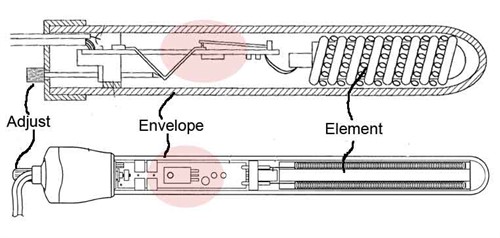
Aquarium heaters come in two basic flavors, those with electronic thermostats and those with mechanical thermostats. Most heaters are of the mechanical variety but some newer models are electronic. Both styles have the same basic parts with the exception of what regulates the temperature and/or energizes the heating element. Shown below are basic diagrams (taken from the Google patents website) of both styles of heaters.

  Mechanical and Electronic Aquarium Heater Diagrams 
 
Image showing drawings of both mechanical (top) and electronic (bottom) aquarium heaters. The areas in red indicate the only significant differences (described below).
 

Both types of heaters share common parts such as the envelope, heating element and temperature adjustment knob. The envelope may be made of glass or titanium, its purpose is to keep the internal components of the heater dry. The heating element is simply a piece of resistance wire that is energized with 120V from the mains supply that the heater is plugged into. The heating element is either ON or OFF (it does not vary in temperature) and is controlled by the thermostat (shown in red above). This is where the similarities end.


Theory of Operation

The mechanical style heater has what is called a bi-metal thermostat. It is comprised of two dissimilar metals bonded together. These metals expand and contract at a different rate when heated or cooled causing the bi-metal strip to curve as the temperature changes. There is an electrical contact at one end of the bi-metal strip. As the bimetal strip bends it moves the contact towards (or away) from another contact. The adjustment knob either varies the distance between the contacts or varies the tension on the bi-metal strip via a spring. This adjustment distance (or pressure) is what allows the heater to be set for a specific temperature by forcing the bi-metal strip to move further (or with more force) to create an electrical connection between the contacts.

The electronic style heater has an electrical temperature sensor inside. As the aquarium temperature rises and falls, the output voltage of the sensor varies. This low voltage signal is used to control an electronic (solid state) switch that has no moving parts. This electronic switch (known as a Solid State Relay or SSR) turns the heating element ON and OFF according to the setting on the control dial.


The Stark Reality

The mechanical style thermostats suffer from several problems that are an inevitable reality of their design. The bi-metal thermostats are very small and delicate. The constant bending causes rapid metal fatigue and therefore the bi-metal strip is rather prone to breaking. The electrical arcing across the contacts also takes its toll and it is not uncommon for the contacts to weld themselves together. The truth is that mechanical aquarium thermostats fail with alarming regularly. The failure usually leaves the thermostat in the ON position causing a rapid overheating of the display tank.

The electronic style thermostats also have many problems. Put simply, the circuit design in most models leaves a lot to be desired. These simplistic circuit topologies are designed to be cheap to manufacture with a low component count (to keep costs down). They circuits have a fairly high failure rate and commonly fail in such a way that the heating element remains energized.


Other Problems

Even though many heaters are sold as fully submersible, constant immersion is not a good idea. It is very common for the watertight seals to leak and allow the internal components to become wet or flooded. This can be deadly for you or your livestock. It is best practice to situate your heaters so that the heads are not submerged, no matter what the manufacturer says. I will have more to say about this in the best practices section.

Running a heater out of the water or with the heating element not fully below the waterline is also a common cause of heater failure. The heating element directly heats the envelope which in turn heats the water. The water quickly pulls the heat away from the envelope. Dangerous temperatures can develop very quickly if the heating element is not fully below the waterline. Overheating can rapidly damage the seals, electronics, thermostat, element and the envelope. Once a heater is run "dry" it should be thrown away (even if to looks fine)!   


Divide and Conquer

The bottom line is simple! Aquarium heaters (of all makes and models) fail at an alarming rate. The failure modes are inherint to the design of the components and not something we can fix. We can, however, use some basic logic to create a reasonably fail-safe system out of components that are not fail-safe when used alone. 

Ignoring the real world math, we can make some basic assumptions. Lets assume that a 1000W heater has stuck in the ON mode and it raises the water temperatre 2 degrees every hour. We can the assume that a stuck 500W heater would only raise that same tank's temperature 1 degree every hour. We can further assume that a stuck 250W heater would only raise that tanks temperature .5 degrees an hour!

From the above logic, it should be fairly obvious that using several small heaters is much safer than using fewer large heaters. By separating the heating duties between several units, no single unit has the ability to rapidly overheat the tank in the event of a malfunction. Furthermore, heaters that fail in the off position will be backed up by the other heaters in the system! The use of multiple small heaters creates a fault tolerant heating system.


Dedicated Controllers

The use of multiple small heaters adds a layer of redundancy and safety to the aquarium's life support system, however, there is more that can (and should) be done to prevent catastrophic failure. Fault tolerance (as described above) can be further enhanced by the addition of a fail-safe system.

A dedicated temperature controller can (should) be used to regulate the aquarium's temperature. Industrial/commercial units such as the Ranco ETC series are magnitudes more reliable than the thermostats that are built into the hobby heaters. The controllers are designed to operate reliably in demanding industrial environments and have a very low failure rate. Many hobby heaters come with controllers that mimic the look and functionality of the commercial units, but make no mistake, they are nowhere near as reliable. The hobby controllers are actually not much better than the thermostats built into the heaters.

The best way to utilize a controller is to set the thermostats on the individual heaters a few degrees above the controller's set point. The controller will turn the heater ON and OFF as demand requires. The heaters' internal thermostats will prevent the heaters from continuing to run in the rare event that the dedicated temperature controller malfunctions (sticks in the ON position). This is the fail-safe! The internal thermostats will not be prone to metal fatigue or arc damage because they are not used during normal operation. 

Dedicated aquarium controllers such as the Digital Aquatics Reefkeeper, MCU Research Lighthouse, Neptune Systems AquaController, Elos Biotopus, etc. have all proved to be somewhat reliable, but there are sporadic reports of various failures of these systems. The bottom line here is also very simple! These are NOT dedicated temperature controllers, and instead, operate with many different inputs and user programmable options. These units can be attached to various combinations of inputs and outputs and at the same time have their logic programmed by end users. The reality is that these units are not nearly as reliable compared to a dedicated temperature controller such as the Ranco ETC series. Leave the life support to tried and tested, dedicated units and let the aquarium controller handle the data logging and lighting.


Placement

Heater placement is a very important consideration in the design of an aquarium system, especially when using a dedicated temperature controller. The heater should always be slightly downstream of the temperature probe (unless the system, is sump-less). Both the heater and the temperature probe need to be placed so that they will always be submerged (only the heater envelope), even with the pumps are off. This means that they should be attached to the back wall of the display tank or in the input compartment of the sump. The overflow box is only an option of it stays full of water when the pumps are not running. The return compartment of most sumps is not typically a good area to place a heater. The water level in the return compartment can drop substantially due to evaporation and expose the heater envelope to the air. Placing the temperature probe and heater in different areas if the system is usually a recipe for trouble. With the components separated it is possible that a pump failure could allow the heater to function erratically and overheat part of the system.

Flo-Control PVC Compression Fitting

A safe and unobtrusive way to attach the heaters is through the sidewall of the sump. This can be done with a standard bulkhead combined with a PVC compression fitting. There are several manufacturers of the compression fittings. One such company is Flo-Control (NDS) out of Burbank, California. Here is the catalog page at the manufacturer's website. You also buy the "kits" with a bulkhead and compression fitting at jehmco.com. They are listed as "heater adaptor for sumps". Installing the heater through the sump wall ensures that the heater will always stay submerged and ensures that water can never get inside.

Peentair Aquatics Heater ModuleA second option  is to use a heater-well such as those manufactured by Pentair Aquatics. The heater-well also keeps the top of the heater from ever getting wet. They can be plumbed in-line with the return pump or overflow system. Care should be taken when using this type of system. The heater will need to have a fail-safe switch that turns it off in the event that the return pump is off, otherwise, the heater may be allowed to run dry.

I prefer the bulkhead method because it takes up much less room. The only drawback is that the sump compartment has to be drained to replace a faulty heater. If space is not at a premium then heater-wells are a viable and smart option.


Sizing

A properly sized heating system will have enough capacity to maintain the system target temperature on the coldest days of the year. Oversizing the system increases risk by shortening the time period that it takes a stuck heater to push the tank to a critical temperature. Even if best practices are followed and the heater setup is fault tolerant (multiple heaters) and fail-safe (dedicated controller in conjunction with the on-board thermostats) it is wise to size the heaters properly.

A baisc guideline is to have three to five watts per gallon for every 10° Fahrenheit above room temperature that you wish to have keep the tank temperature.

((Desired Tank Temp − Room Temp) ÷ 10) × System Gallons × 3 = Watts Desired

Example:
100 Gallon System
78° Target temp
67° Room temp

Using both the low and high values:
(78 − 67) ÷ 10) × 100 × 3 = 330 Watts
(78 − 67) ÷ 10) × 100 × 5 = 550 Watts

A good place to start would be to use (4) 100W or (3) 150W heaters.

Lets look at a simple fault scenario with this example system. We will assume that there is no temperature controller and (1) of the 150W heaters sticks on the ON position. The 150W heater puts 511 Btu/hour. It takes 833 BTUs to raise the 100 gallons of water 1° Fahrenheit. The tank will rise .6° Fahrenheit every hour that the 150W heater is stuck on. Contrast that with the single 500W heater that would raise the tank temperature 2° Fahrenheit every hour that it is stuck on! For more details of the math and how these numbers were derived, please see my article "Thermodynamics for the Reef Aquarist".


Conclusion

The heater is an important part of your system. Heater failures are very common and can cause significant damage to your system. Even a modest aquarium represents a significant investment in both terms of money and time. Relying on a $25 thermostatic heater to protect that investment is illogical. Some brands of heaters fail more than others, but it is very easy to implement an inexpensive plan that will greatly reduce, if not nearly eliminate that chances of a heater causing the loss of livestock.

  • Use several small heaters instead of one large heater
  • Connect the heaters to a Ranco, Johnson Controls or similar controller
  • Don't place the heater in an area where it can run dry
  • Don't fully submerge the heater
  • Size the heaters to match the system, bigger is NOT better!
  • Don't be fooled by sales pitches, all of the heaters are petty much the same

-BeanAnimal

]]>
Thermodynamics for the Aquaristhttp://beananimal.com/articles/thermodynamics-for-the-aquarist.aspx@updateDatehttp://beananimal.com/articles/thermodynamics-for-the-aquarist.aspx  

Q: What size aquarium heater do I need?
Q: Do I need an aquarium chiller? What size aquarium chiller do I need?

A:If you want to move past the general "rules of thumb" thrown around (even here on beananimal.com) you can use our favorite subject (physics) to get a better idea of how much heat your aquarium will give up to (ro gain from) the surrounding room. If we know how much heat the aquarium will lose to the room, we know how much heat we must add to maintain a constant target temperature in the aquarium. To answer the question, we need answer a few more questions to help us work through the steps:

1) Calculate how much heat the tank will lose to the room during the time period in question. We will need to look at both conduction (heat through the glass) and evaporation (heat lost due to the phase change from water to vapor).
2) calculate how much heat is added to the tank during the time in question. Things like lights and pumps add heat back into the system.
3) Determine the difference between the heat lost and the heat added so that we can properly size a heater.

Lets get started...


Q: How much heat is transferred through the aquarium glass into the room?

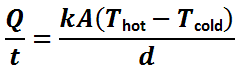
A: We can use Fourier's Law (the law of heat conduction) to examine the conductive heat transfer from your fish tank to the surrounding environment. So that we do not need to duct tape our heads together to keep the brain matter from exploding, we can skip the definition and assume that Joseph Fourier knew what he was talking about back in 1801. The Fourier Conduction formula can be used to give us an idea of how fast heat will travel through a solid, in our case from the aquarium water, through the glass panel and into the air in the room.

Thermal Conductivity Illustration

Fouriers law of Conduction

Q/t

=

Heat Conduction in BTU/hour 

k

=

 Thermal Conductivity

A

=

 Area in square feet

d

=

 Thickness in feet (inches ÷12)

T

=

 Temperature in degrees Fahrenheit

We can use the equation to determine how much heat will flow through the glass panels of the aquarium. We will assume that we know the daily evaporation of the aquarium through the open top and therefore we will ignore convective heat loses (minimal in comparison) through the open top of the aquarium. We will also treat the bottom of the tank the same as the sides, even though it is covered by a mass of sand and partially insulated by the stand.

Example: As an example we will look at a typical 75 gallon aquarium with dimensions of 48" x 18" x 20" constructed with 3/8" glass and a target operating temperature of 80° F with an ambient room temperature of 72° F.

Area:
front 48" × 20" = 960 sq. inches
Back 48" × 20" = 960 sq. inches
Left 18" × 20" = 360 sq. inches
Right 18" × 20" = 360 sq. inches
Bottom 48" × 18" = 864 sq. inches
_________________________________

So:
960 + 960 + 360 + 360 + 864= 3505 sq. inches (simply add up the total area of all of the panels)

Then:
3505 sq inches ÷ 144 = 24.340 sq. feet (there are 144 square inches in a square foot)

d: (thickness)
3/8" = 0.375 inches
0.375 ÷ 12 = 0.0313 feet (convert inches to feet)

k: (thermal conductivity)
We can find the thermal conductivity of glass by looking it up in a table. The thermal conductivity of glass can vary depending on the types of minerals found in it. For our purposes we will use k = 0.578 BTU/hr ft°F  (if you aquarium is made of acrylic, then your thermal conductivity constant will be k = 0.12 BTU/hr ft°F and likewise for wood it will be k = 0.07 BTU/hr ft°F)

Once we plug in the numbers our equation (for the glass tank in our example) will look like:

Fourier Example Calculation

Doing the math we get a result of 3595.79 BTU/hour of heat transfer. We still need more information to properly size our heater... Read On!


Q: How many Watts are in a BTU?

A: In reality the question should be "How many Watt/hours are in a BTU?".  A Watt is a measure of energy used per unit time (also called POWER).

1 BTU = 0.293 Watt/hours
1 Watt/hour = 3.412 BTU

With that handy information we can figure out how many Watts it will take to keep our aquarium at the target temperature. But wait! We have a few more things to consider...


Q: How many BTUs does the aquarium lose per gallon of saltwater evaporated?

A: In the spirit of keeping things simple, we will forgo the duct tape around the head and skip the scientific definitions in favor of some basic facts. At atmospheric pressure, the Latent Heat of Vaporization (evaporation) of pure water (at sea level) is about 970.4 BTU/lb. Seawater (the stuff in your reef tank) has a slightly lower Latent Heat, lets say 960 BTU/lb. Seawater weighs about 8.5 pounds per gallon. So it takes somewhere in the neighborhood of 8160 BTU to evaporate 1 gallon of seawater. But how does that help us?  Read on...


Q: How many BTUs does it take to raise or lower the water temperature in my aquarium?

A: It takes 1 BTU to raise (or lower) 1 Pound of water 1° Fahrenheit. That is, the specific heat of pure water is 1.0. Pure water weighs about 8.34 pounds per gallon. So it takes about 8.34 BTU to raise 1 pound of water 1° F. That is likely close enough for most of us.

For those of you wish to be a little more accurate:

The specific heat of saltwater (seawater) is about  0.952 and seawater weighs about 8.5 pounds per gallon. So therefore it takes about 8.1 BTU to raise (or lower) 1 gallon of seawater 1° F.


Q: How much heat does my submersible pump add to the aquarium?

A:For our purposes, almost 100% of the energy consumed by a submersible pump (mag-drive, powerhead, etc.) is converted to heat in the tank! The simple fact is that if you were to take a heater that consumed exactly 100W and a powerhead that consumed exactly 100W and placed them each in a 5 gallon bucket with a lid, both buckets would reach the same temperature in the same amount of time! Why? Much of the energy consumed by the pump is directly shed as heat into the water. What is left does work and that work (moving water) causes friction (water moving against the objects and walls of the tank), most of which is converted to heat in the tank. When attempting to calculate the heat load on your tank, you should add up the total wattage of all submersible pumps in the system!


Q: How much heat does my external pump add to the aquarium?

A: This is not as cut and dry as a submersible pump. Different styles of external pumps contribute different amounts of heat into the system. Some external pumps are cooled by the water flowing through them (most mag-drive pumps). Most Jet style centrifugal pumps are fairly well isolated from the system and may only shed 5%-25% of their heat into the aquarium (remember they move water and create friction, no matter what). Is there a rule of thumb? Not that I know of! I would assume maybe 80% heat transfer for external mag-drive style pumps and 15%-25% heat transfer for other external pumps, especially if they are located in a closed stand!


Q: How much heat do my lights add to the aquarium?

A:This also is a complex question and depends on many factors. For our purposes we can simply use the radiant energy of the lighting family as a reasonable estimate of the heat transfer into the aquarium. If you look at the chart below, you will see that both Metal Halide and Fluorescent lighting technologies both have similar radiant energy figures. LED lighting has a much lower radiant energy and therefore contributes less heat directly to the water. It should be noted that no matter what lighting technology is used, they ALL contribute exactly the same amount of overall heat (per Watt) into the room! Please examine the following table (available from the United States Department of Energy).
Thermal properties of white light sources

In other words, if you have 250W worth of Metal Halide lighting above your aquarium, you can somewhat accurately conclude that 63% (about 157 Watts) of that energy will end up as heat radiated into the tank. Note that a portion of that 157 Watts of energy will never make it into the tank and some of it will escape the tank before it is turned to heat in the water. At the same time, a portion of the leftever 37% that is shed from the fixture via conduction and convection (trapped in the hood and/or room) will contribute to heat in the tank. If the aquarium does not have a hood, then you can assume that somewhat less heat will be transferred to the aquarium water. If the aquarium has a poorly ventilated hood then you can assume that more of the total energy will end up as heat in the aquarium water. There are simply too many variables to attempt to actually make an accurate calculation further than the riugh estimated explained above.


Q: Can you help me put it all together?

A:You know how to calculate how much heat your aquarium will lose to the room. You know how many Watt/hours it takes to produce a BTU of heat. You know how to, based on the volume of water in your aquarium, how many BTUs it takes to raise or lower the temperature of the saltwater in your aquarium. You know how much water your aquarium evaporates over a 24 hour period. It is a simple task of putting the numbers together to determine how big of a heater or chiller you may need.

We will look at (2) examples using the information provided above.


Example 1

Equipment:
75 gallon glass aquarium
100W external return pump in the stand
50W submersible skimmer pump
300W Metal Halide lighting
10W powerhead

Environment:
Target tank temperature 80° F.
Room Temperature 72° F.
Evaporation 2 gallons per day

Do I need a heater or chiller during the day?

Answers coming soon...


Example 2

Equipment:
75 gallon glass aquarium
100W external return pump in the stand
50W submersible skimmer pump
300W Metal Halide lighting
10W powerhead

Environment:
Target tank temperature 80° F.
Evaporation 2 gallons per day

My wife turns the thermostat down to 65° F. at night (from 9:00 P.M. to 9:00 A.M.) during the winter and my target tank temperature is 78° F., how big of a heater do I need? How much will it cost to heat the tank during those hours?

Answers coming soon...

]]>
ReefCentral Crash Rumorshttp://beananimal.com/articles/reefcentral-crash-rumors.aspx@updateDatehttp://beananimal.com/articles/reefcentral-crash-rumors.aspxIt would appear that sometime on Wednesday July 15, 2009, ReefCentral.com suffered an outage due to a database upgrade. 

Posts appearing to come from "beerguy" and "mhurley" (two of the system administrators) started showing up on various forums. The forged posts indicated that ReefCentral was down for good. This is simply NOT true. ReefCentral is alive and well and simply down for needed database maintenance and upgrade.

The initial lack of a status update on the ReefCentral.com homepage has helped to fuel these rumors. There are clearly some bottom feeders (no pun) that have attempted to take advantage of the situation to drive traffic to their own sites.


From the RC homepage:

Hello RC Members.

Sorry for the interruption. We'll be back in a little while, I need to check something.

To the folks spreading rumors and making up quotes, it's pretty sad when you have to resort to lying to try and get members.

The truth is that during an upgrade to mySQL we encountered an error that needed to be corrected. Unlike most sites, our database is very large and routine checks can take quite a long time to run. That's one of the reasons why we're one of the few sites that runs a full nightly backup. We'll be back this morning with virtually zero data loss. Sorry to disappoint the folks forging the emails.

Slander and libel are pretty serious things.
Cheers


]]>